

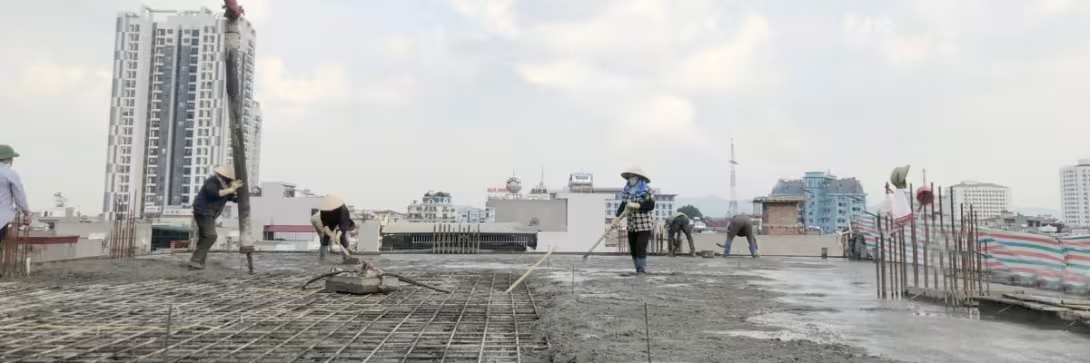
Concrete work in the construction of building floors in general, or the construction of flat slab without beams solutions in particular, is an extremely important stage. Concrete work not only ensures the strength and durability of a structure but also plays an important role in ensuring structural uniformity, load-bearing capacity, safety, and usability.
The Ubot flat slab solution is no longer an unfamiliar concept to engineers and construction contractors, thanks to its practicality and feasibility, as it can be applied to projects of various scales while demonstrating clear economic efficiency.
With experience in implementing and providing construction guidance for numerous flat slab without beams projects, LPC explores the standards for concrete work acceptance and proper flat slab curing practices.
General Requirements and Regulations for Concrete Work
Vietnamese Standard TCVN 9340:2012 is the standard applied to concrete work. Concrete floor casting may only be carried out after the formwork and reinforcement work have been inspected and accepted in accordance with applicable regulations and standards.
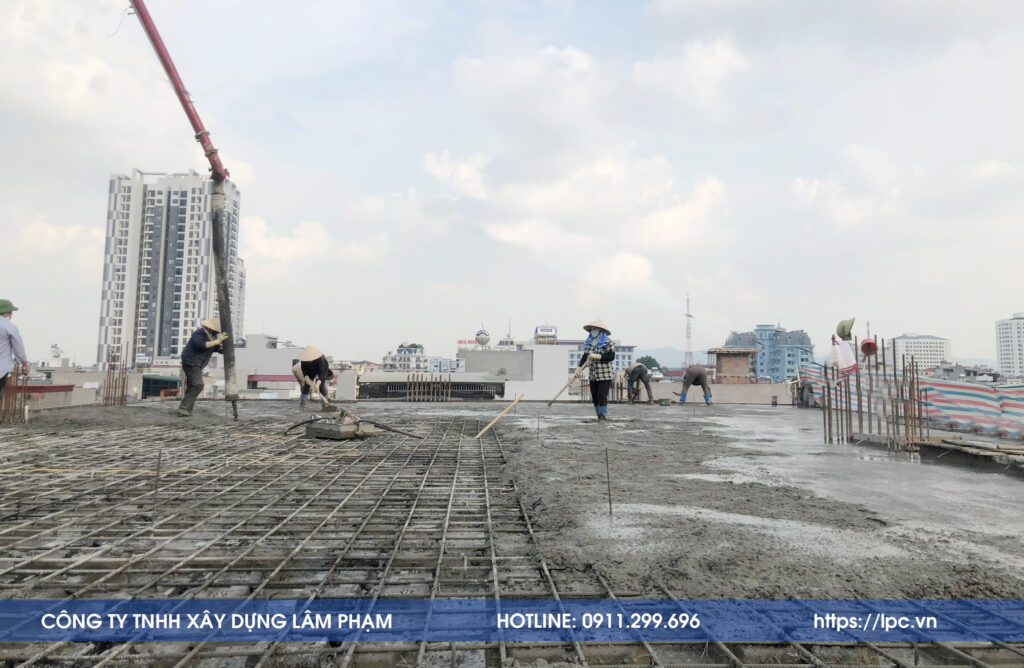
Based on the technical requirements and standards of the project, the concrete mix must be designed and proportioned based on test parameters such as compressive strength, shrinkage value, slump, setting time, flow spread, and others. In particular, the time required for the slump to decrease from the design value to 6–8 cm must be determined. According to Clauses 1.3 and 1.4, this period is calculated from the completion of Layer 1 until the beginning of Layer 2 casting.
Concrete work for flat slabs without beams is carried out in two layers. Layer 1 concrete must have sufficient slump to ensure that the concrete fills the area beneath the bottom of the void formers during vibration in the recessed areas.
Layer 2 concrete is cast when Layer 1 has developed adhesion to the plastic void formers while still complying with Vietnamese Standards TCVN 4453:1995 and TCVN 9340:2012.
Beam and Slab Concrete Casting
For hand-mixed concrete, the input materials must meet technical requirements. Sand and aggregates must comply with Vietnamese Standard TCVN 7570:2006. Aggregates for concrete and mortar must also meet technical requirements, and cement must comply with Vietnamese Standard TCVN 6260:1997.
At LPC, engineers are trained in site skills and have strong technical expertise, ensuring that projects and concrete work are always carried out in accordance with technical requirements.
Beam and slab concrete casting is one of the important stages in the construction of flat slab without beams solutions. The vibration equipment for Layer 1 concrete must be selected with an appropriate size to ensure effective concrete placement around the concealed beams and beneath the void formers. A poker vibrator or surface vibrator can be used for the upper concrete layer to ensure effective compaction.
Flat Slab Without Beams Concrete Casting Process
Concrete Casting Using a Boom Pump
- Clean and wash the slab
- Select the pump location that provides the most convenient boom rotation
- Keep the pump pipe vertical. The pipe outlet should be no more than 50 cm above the void former surface. A flexible hose can be attached to the pump pipe to limit the concrete discharge speed.
- Layer 1: Use a slow pumping speed to prevent excessive concrete accumulation in one location and displacement of the void formers.
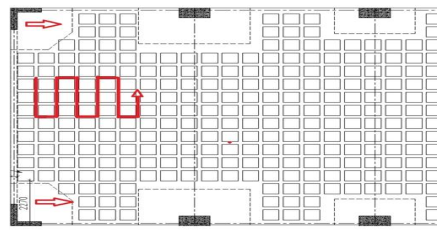
Move the pump pipe in a zigzag pattern, moving it once every 2–3 rows of void formers.
- Pour enough concrete into the void-former gaps so that after compaction, sufficient concrete remains to fill the base of the void formers and create a solid support structure.
- Each pump pipe should be accompanied by two vibrators, compacting all four sides of the void former. The vibration time is approximately 5–7 seconds. Compact all corners thoroughly so that the concrete forms a solid mass around the base of the void former. Avoid vibrating for too long in one location, as this may cause the void former to float.
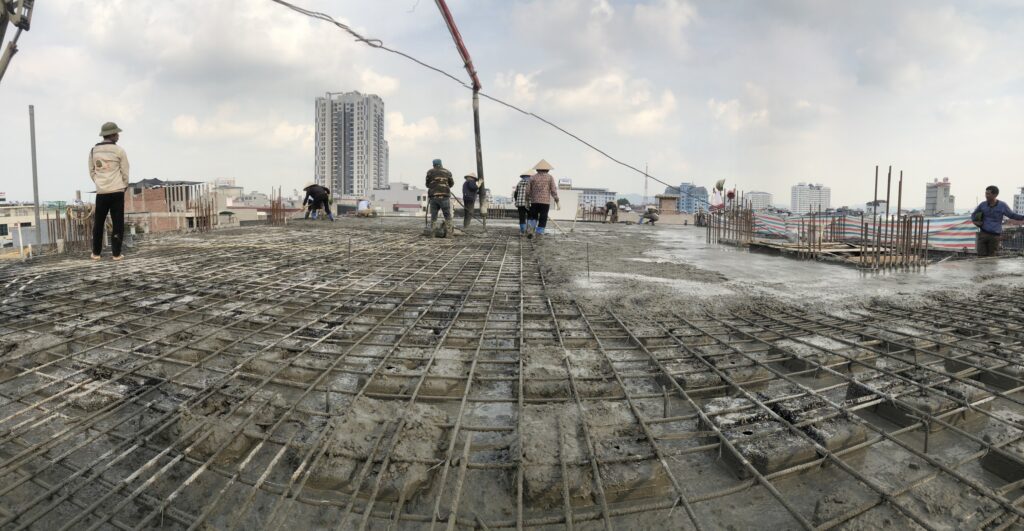
- Once the surface of Layer 1 concrete has begun to set, proceed with casting Layer 2. The time between Layer 1 and Layer 2 depends on weather conditions and the construction method. Note that Layer 2 does not require intensive vibration; only lightly vibrate the surface and avoid deep vibration that reaches Layer 1.
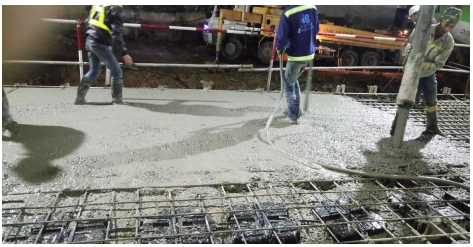
- Finish the surface, paying attention to areas with lowered slab levels.
Concrete Casting Using a Stationary Pump
- Reinforce the contact points between the pump and the slab using wooden planks, steel plates, or vehicle tires to prevent the void formers from breaking when the pump jerks or moves.
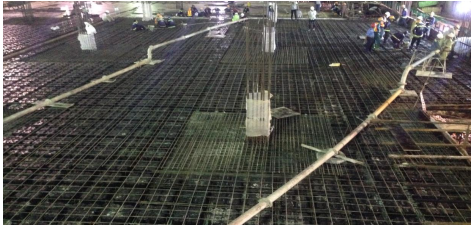
- Pump concrete first into areas without void formers, such as column heads, beams, walls, and void-former gaps. Then use a vibrator to move the concrete toward the void-former areas. Coordinate the pumping and vibration operations smoothly. Maintain a moderate pumping speed and avoid placing too much concrete in one location before it can be compacted. Then gradually retract the pump pipe toward the subsequent areas.

- Concrete is poured into the void-former gaps. The amount of concrete should not completely cover the top surface of the void formers in order to prevent floating and to maintain good control over the vibration points. Note:
+ Move the pump pipe and vibrate immediately at each location to push the concrete toward the more distant areas
+ Vibrate sufficiently for the concrete to fully fill around the base of the Ubot void formers; excessive vibration may cause the void formers to float
+ Compact all areas around the void formers.
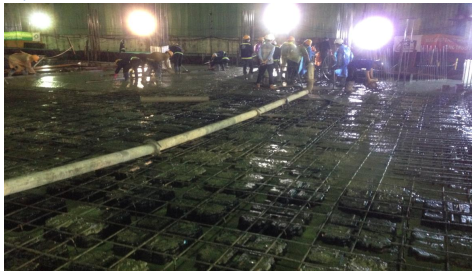
- Cast to the design level, use a rake to lightly level and compact the concrete, perform surface vibration, and finish the surface.
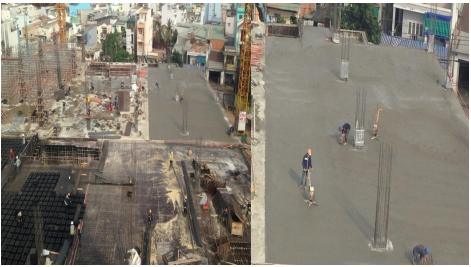
Read more: Concrete Casting Process for Flat Slab Without Beams Solutions
How to Cure Concrete Work Effectively
Curing concrete in flat slab without beams solutions is similar to curing conventional fresh concrete. However, site personnel need to pay attention to the following points:
- The concrete mix is designed with a slump of 16 ± 2 cm for a boom pump and 18 ± 2 cm for a stationary pump, using 1×2 aggregate. These concrete mixes have high slump and high strength, so special attention must be paid during the curing process.
- Limit the use of R3/R7 plasticizing admixtures. If these admixtures must be used, strict curing requirements must be established to prevent shrinkage cracking. Because the slab is hollow and has a large thickness, concrete hydration will take longer. Therefore, the concrete curing process must always comply with the applicable standards.
- To reduce transverse cracking on the slab surface, the cement content in the concrete mix can be reduced and, where possible, concrete with high early strength should be avoided.
- Begin curing immediately after completing the concrete casting work. Curing must be carried out continuously for at least 7 days.
- The slab shoring levels must comply with applicable standards. When casting concrete on an upper floor, at least 2 levels of shoring must be maintained to prevent construction loads from exceeding the design load.
Construction Joints in Flat Slabs Without Beams
Construction joints in concrete work are designed to divide the floor area into sections with sizes appropriate to construction capacity and to limit the effects of concrete shrinkage.
Each construction section should not exceed 40 m in length or 1,200 m² in area. This helps ensure effective concrete work during construction.
When casting concrete over a large area, the casting zones must be planned so that the joints between areas within the same pour do not result in a situation where the “concrete placed first has already begun to set (the concrete has started to dry), while the concrete placed later has not yet reached the area.” This depends heavily on the concrete pouring direction and the division of pouring zones within the same pour.
When casting a slab using multiple pumps, the pumps and concrete pouring directions must be arranged appropriately. If the slab area is too large, construction joints may be divided according to the actual conditions. The waiting time between adjacent pouring zones should not exceed 60 minutes and also depends on weather conditions during concrete casting.
Concrete work plays an important role in the construction of buildings, ensuring the durability, safety, and usability of structures.
Selecting an experienced consulting and construction guidance firm with expertise in implementing flat slab without beams solutions and the various stages of concrete work can help developers optimize costs, improve economic efficiency, and maximize building performance.
— Lam Pham Construction Co., Ltd. – LPC
Hotline: 0911.29.9696
Website: https://lpc.vn
Facebook: Lam Pham Construction
YouTube: Lam Pham Construction
TikTok: Lam Pham Construction
More articles
All news

Have a project in mind?
LPC engineers are ready to share their experience and propose the right solution for your project.