Green Building Materials for a Green Future
Every year, thousands of construction projects are built in Vietnam. Although infrastructure has improved significantly, environmental pollution, construction waste, and scrap materials have also increased considerably, damaging the urban landscape and affecting people's health. If outdated construction solutions continue to be applied, it will be impossible to improve the quality of the living environment for everyone. This is why green building material solutions have emerged and are gradually becoming a trend in Vietnam's construction industry. A notable example is the Ubot flat slab.
What Are Green Building Materials?
Green building materials are environmentally friendly and safe for human health, such as Ubot lightweight slabs, green wall cladding, lightweight concrete, recycled metals, and more.

With these new solutions, pollution can be significantly reduced, creating sustainable value for the entire industry. The introduction of green building materials also helps contractors save on material costs, reduce labor requirements, and shorten construction time effectively.
Reference: Construction Process for Flat Slabs Without Beams
Why Should We Use Green Building Materials?
Vietnam is a developing country, so improving infrastructure and civil construction is one of its top priorities. This development contributes 40% of total CO2 emissions, causing environmental consequences. Therefore, reducing emissions from the production of building materials and saving on materials, machinery, labor, and construction time will make a significant contribution to reducing energy use and emissions.
With the development of science and technology, innovative green building material solutions not only deliver greater economic efficiency for developers and internationally standardized quality for designers and contractors, but are also more environmentally friendly.
How Have Green Building Materials Developed in Recent Years?
In recent years, Vietnam has made significant progress in applying green building materials in construction. This is clearly reflected in the following aspects:
– Using green building materials to replace traditional materials.
Traditional materials are construction materials commonly obtained from nature and processed by people, such as wood, stone, concrete, and so on. Because they originate from natural resources, continuous extraction and use can seriously affect our ecosystems. Therefore, green materials have been researched and introduced into construction projects.
Reference: Top 3 Home Renovation Trends
Green building materials are often made from recycled materials, have high durability, and consume less energy throughout their service life. Green materials currently being used include Ubot flat slabs without beams, ultra-lightweight concrete, engineered wood, and more.

– Applying environmentally friendly green building material solutions.
In addition to using green building materials instead of traditional materials, Vietnam's construction industry is also implementing environmentally friendly construction solutions. Buildings are being designed in increasingly scientific ways to improve energy efficiency. Saving energy and reducing harmful emissions into the environment are also effective ways to improve pollution conditions.
Today, the construction industry is making efforts to develop buildings that meet green building standards across the country. Some specific criteria for achieving green building certification include:
- Energy savings during operation.
- Protection of water resources and reduction of waste and pollution.
- Optimized costs throughout the building's life cycle.
Read more: Ubot in a Secondary and High School Project
UBOT – A Green Building Material Solution for a Green Future
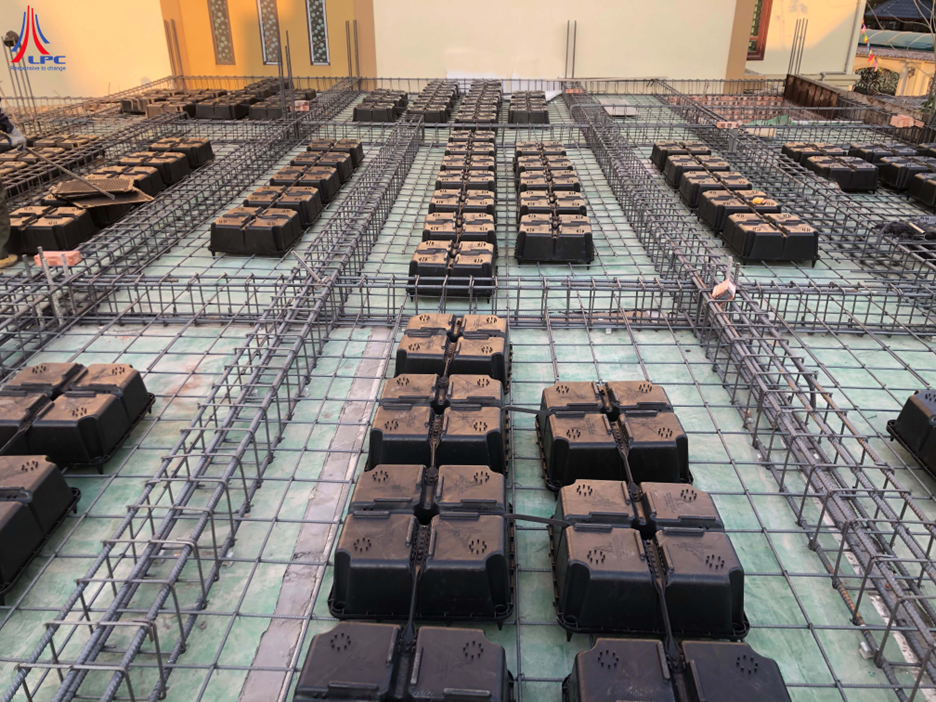
UBOT Void Former Solution (Ubot void-forming module) made from recycled Polypropylene is a formwork solution that creates a voided slab system with a flat underside and no beams, allowing for large spans.

The Ubot void former was invented by the world-renowned Daliform Group in Italy and was first transferred to Vietnam in 2012 by Lam Pham Construction Co., Ltd., replacing outdated lightweight slab methods that had many limitations. To date, the Ubot flat slab solution has been implemented in hundreds of large- and small-scale projects both domestically and internationally, and has been selected by many developers as a new building material solution for their projects.
Read more: Economic Efficiency of Ubot Slabs
Ubot's outstanding advantages, which give LPC confidence in introducing it to customers, include its stackability, ease of transportation, outdoor storage capability, and exceptional durability. Its improved shape, flexible thickness and dimensions, and excellent fire resistance further enhance its performance. During and after concrete placement, Ubot does not deform under the weight of concrete or construction loads.
Compared with traditional reinforced concrete slabs, using Ubot creates flat, beamless slabs with greater clear height, reduces the thickness of the beam-and-slab system, makes it easier to install technical piping systems, and also enhances the aesthetics of the building.

Another advantage of Ubot lightweight slabs is the column-spacing system. Compared with traditional slabs, the Ubot lightweight slab system reduces the number and cross-sectional dimensions of columns, making column placement more convenient in buildings that require open spaces, such as shopping centers, parking garages, and residential buildings.
Using Ubot slabs also reduces the thickness of the beam-and-slab system; increases the number of floors; improves sound and thermal insulation; reduces slab weight by 10–30% compared with conventional slabs; reduces the total slab load transferred to the foundation by 10–30%; reduces foundation dimensions; is environmentally friendly; and reduces MEP costs.
Read more: Long-Span Flat Slabs in Modern Architecture
With the advantages above, using Ubot can save 10–20% of the total project cost by reducing 10–30% of the costs of concrete, reinforcement steel, formwork, labor, technical systems, and other items.
It can be said that construction is the industry that uses the largest volume of materials. It is also the industry that consumes the greatest amount of natural resources such as aggregates, minerals, soil, water, energy, vegetation, and more to build civil, industrial, and transportation projects. At the same time, the industry also releases large amounts of waste into the environment, including solid waste, greenhouse gases, and noise, causing environmental pollution.
To help protect the current living environment and that of future generations, using environmentally friendly green building materials and limiting the destruction of nature are essential today. We hope that the information about green building materials provided above by LPC will help everyone choose the most suitable, high-quality construction materials while optimizing costs. Continue to follow and support us in our upcoming articles to receive more useful information!
—- Lam Pham Construction Co., Ltd. – LPC
Hotline: 0911.29.9696
Website: https://lpc.vn
Facebook: Lam Pham Construction
Youtube: Lam Pham Construction
Tiktok: Lam Pham Construction
Related articles
View all
LONGITUDINAL BENDING COEFFICIENT η OF REINFORCED CONCRETE COLUMNS SUBJECTED TO ECCENTRIC COMPRESSION ACCORDING TO TCVN 5574-2018
According to TCVN 5574-2018, the longitudinal bending coefficient η is a parameter used in the structural calculation of reinforced concrete columns subjected to eccentric…

Directions for improving the quality of social housing today and in the future
On December 1, 2023, the Hanoi Association of Architects organized a discussion session entitled “Planning and Architecture of Social Housing – Present and Future”. At the…
Series on Foundations (Part 1)
Foundations play an important role in every construction project. To have a beautiful and sturdy home, the foundation must be built firmly and safely.
Building sustainable projects together
Follow expert knowledge from LPC engineers or contact us when you need advice.