LONGITUDINAL BENDING COEFFICIENT η OF REINFORCED CONCRETE COLUMNS SUBJECTED TO ECCENTRIC COMPRESSION ACCORDING TO TCVN 5574-2018
According to TCVN 5574-2018, the longitudinal bending coefficient η is a parameter used in the structural calculation of reinforced concrete columns subjected to eccentric compression. This coefficient accounts for the effect of longitudinal bending on the eccentricity of the axial force eo when calculating the structure according to the undeformed structural scheme.
However, to determine the longitudinal bending coefficient η, it is necessary to know input parameters such as the design internal forces, member dimensions, stiffness of the reinforced concrete member at the ultimate limit state, elastic modulus of concrete and reinforcement, moment about the centroid of the most tensioned or least compressed reinforcing bar, initial eccentricity of the axial force, cross-sectional height of the member, radius of gyration of the member's cross-section about its centroid, and the relative eccentricity of the axial force.
In the article below, LPC will guide readers through the determination of the longitudinal bending coefficient η for reinforced concrete columns subjected to eccentric compression according to TCVN 5574-2018.
1. Input parameters for the longitudinal bending coefficient η
1.1. Design internal forces:
- M, N: internal forces resulting from the application of all loads (dead load + full live load + special loads). TCVN 2737-2023.
- Mdh, Ndh: internal forces resulting from permanent and long-term temporary loads (dead load + long-term live load). TCVN 2737-2023.
1.2. Member dimensions:
- L: member length or distance between its sections restrained against displacement.
- Lo: effective length of the member, determined according to 8.1.2.4.4.
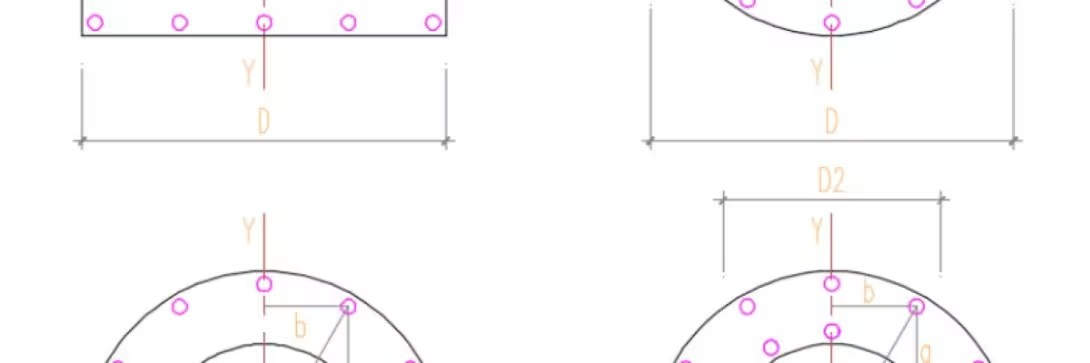
- Rectangular cross-section (b×h), circular cross-section (D), annular cross-section (D1, D2).
2. Calculation of the longitudinal bending coefficient η
2.1. Conditions for applying the formula for calculating the longitudinal bending coefficient η
– 8.1.2.1.2. The structure may be calculated according to the undeformed structural scheme while accounting for the effect of longitudinal bending of the member on its strength when the slenderness ratio Lo/i > 14, by multiplying the initial eccentricity eo by the longitudinal bending coefficient η.
Where:
- eo: initial eccentricity of the axial force, determined according to 8.1.2.2.4
- For statically indeterminate members: eo = max (e1, ea)
- For statically determinate members: eo = e1 + ea
- e1: static eccentricity. e1 = M/N
- ea: accidental eccentricity. ea = min(L/600, h/30, 10mm)
- h: cross-sectional height of the member (depending on the direction being considered). Replace h with D and D1 for circular and annular cross-sections, respectively.
- I: radius of gyration of the member's cross-section about its centroid.
2.2. Calculation of the longitudinal bending coefficient η
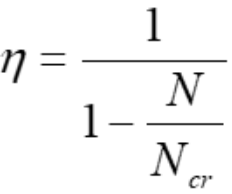
8.1.2.4.2. The value of the longitudinal bending coefficient η when calculating the structure according to the undeformed structural scheme is determined by the following formula:
Where:
Ncr: conventional critical force, determined by the formula:
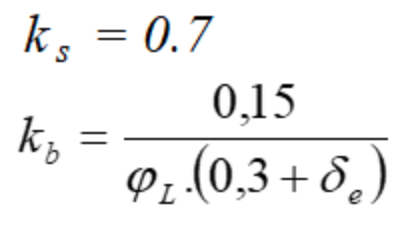
D: stiffness of the reinforced concrete member at the ultimate limit state, determined according to the guidelines for deformation calculations. The value of D may be determined by the following formula:
- Eb, Es: elastic modulus of concrete and reinforcement, respectively.
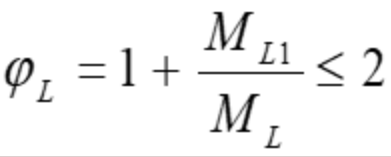
φl: coefficient accounting for the effect of the duration of load application.
- ML: moment about the centroid of the most tensioned or least compressed reinforcing bar (when the entire cross-section is under compression) due to the action of all loads.
ML = M + N.a - ML1: moment about the centroid of the most tensioned or least compressed reinforcing bar (when the entire cross-section is under compression) due to permanent and long-term temporary loads.
ML1 = Mdh + Ndh.a - δe: relative eccentricity of the axial force. (0.15 ≤ δe = eo/h ≤ 1.5).
- Ib, Is: moments of inertia of the cross-sectional area of concrete and the entire longitudinal reinforcement, respectively, about the centroid of the member's cross-section.

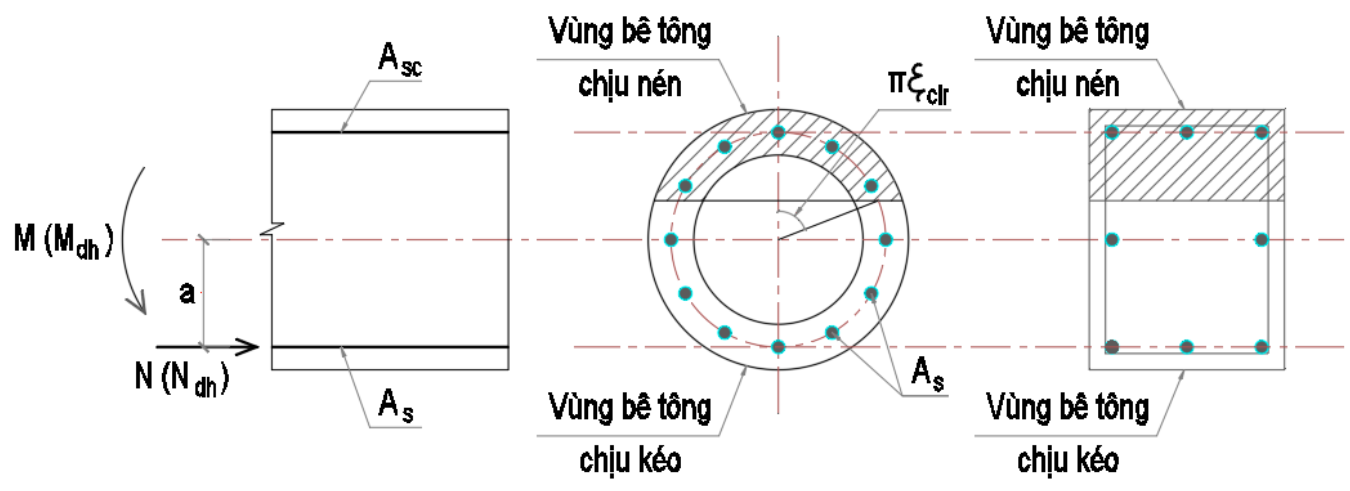
c. Determination of Ib
- + For rectangular cross-sections:
- • Calculated about side b: Ib = h.b³/12
- • Calculated about side h: Ib = b.h³/12
- + For circular cross-sections:
- • lb = π.D = π.D⁴/64
- + For annular cross-sections:
- • lb = π.(D1⁴ – D2⁴)/64
d. Determination of Is
Here, the parallel-axis theorem is used to calculate the moment of inertia (the moment of inertia of the reinforcement about an axis parallel to the axis passing through the centroid of the cross-section of the reinforced concrete column member).
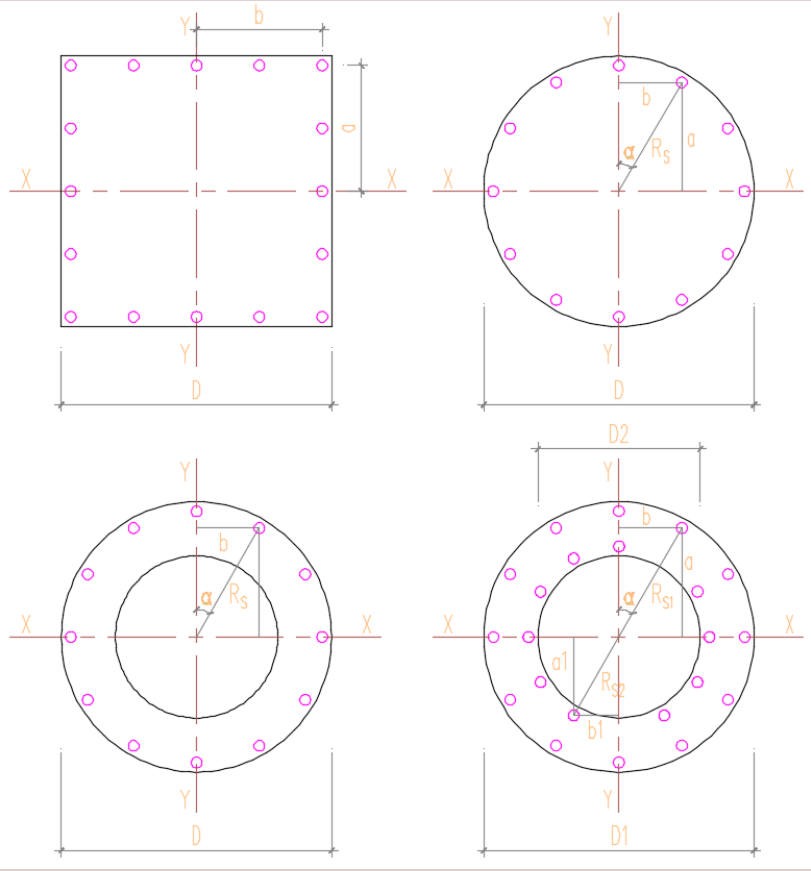
Let Asi and Isi denote the area and moment of inertia of the cross-section of the ith reinforcing bar, respectively. The moments of inertia of the entire reinforcement about the centroid of the member's cross-section in the X and Y directions are:
- • Isx,i = Isi + a².Asi
- • Isy,i = Isi + b².Asi
- • Isx = Σlsx,i
- • Isy = Σlsy,i
The above is LPC’s guide on determining the longitudinal bending coefficient η for reinforced concrete columns subjected to eccentric compression according to TCVN 5574-2018. We hope the information provided in this article will be useful to readers who want to learn more about the longitudinal bending coefficient η!
Lam Pham Construction Co., Ltd. – LPC
- Hotline: 0911.29.9696
- Website: https://lpc.vn
- Facebook: Lam Pham Construction
- Youtube: Lam Pham Construction
- Tiktok: Lam Pham Construction
Related articles
View all
Directions for improving the quality of social housing today and in the future
On December 1, 2023, the Hanoi Association of Architects organized a discussion session entitled “Planning and Architecture of Social Housing – Present and Future”. At the…

Series on Foundations (Part 1)
Foundations play an important role in every construction project. To have a beautiful and sturdy home, the foundation must be built firmly and safely.
Large-span slabs and experience in constructing beamless flat slabs in 2024
Large-span slabs or beamless flat slabs are no longer a new construction material solution and are currently attracting the attention of many investors. With their ability to…
Building sustainable projects together
Follow expert knowledge from LPC engineers or contact us when you need advice.