Large-span slabs and experience in constructing beamless flat slabs in 2024

Large-span slabs or beamless flat slabs are no longer a new construction material solution and are currently attracting the attention of many investors. With their ability to achieve large spans, carry loads effectively, and meet all technical requirements in construction, large-span slabs have been widely applied in many projects of different scales.
As the first company to introduce the beamless flat slab solution to Vietnam, with 13 years of experience in design, supply, and technology transfer, LPC has a thorough understanding of the distinctive structural characteristics and construction experience required to achieve optimal efficiency with beamless flat slabs. Let's explore this with LPC in this article!
1. What is a large-span slab?
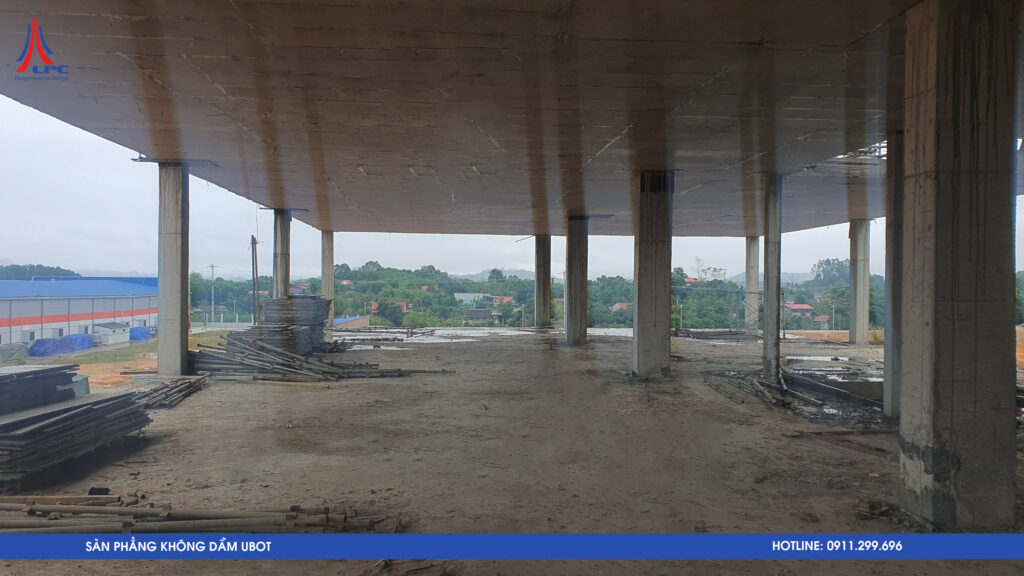
Large-span slabs, or long-span slabs, are reinforced concrete slabs capable of spanning from 7 m to 20 m, helping eliminate intermediate columns, create open and aesthetically pleasing spaces, and make it easier for investors to arrange and optimize functional use. Large-span slabs are often hollowed out internally using materials such as Ubot plastic boxes, foam, bubbles, etc., helping eliminate non-load-bearing concrete, reduce slab weight and concrete consumption while still ensuring structural safety.
In recent years, large-span slabs have been increasingly trusted and used by customers for their outstanding features, especially their ability to achieve large spans and optimize space. Large-span slabs are also applied to many different types of projects: residential buildings, high-rise buildings, industrial construction projects, industrial facilities, shopping centers, schools, hospitals, and more.
There are currently many different types of large-span slabs on the construction market: flat slabs, mushroom slabs, bubble slabs, prestressed slabs, etc. Each type has a different structure and application depending on the architecture and structural design of the project.
2. Common types of large-span slabs today
2.1. Large-span slabs using Ubot plastic boxes
Large-span slabs using Ubot plastic boxes are a European technology. The boxes are made from recycled Polypropylene and have 5 legs positioned between two layers of concrete slab. Ubot hollow box slabs create voids within the slab and reduce slab weight while increasing clear ceiling height. They also offer outstanding advantages in terms of effective sound and thermal insulation.
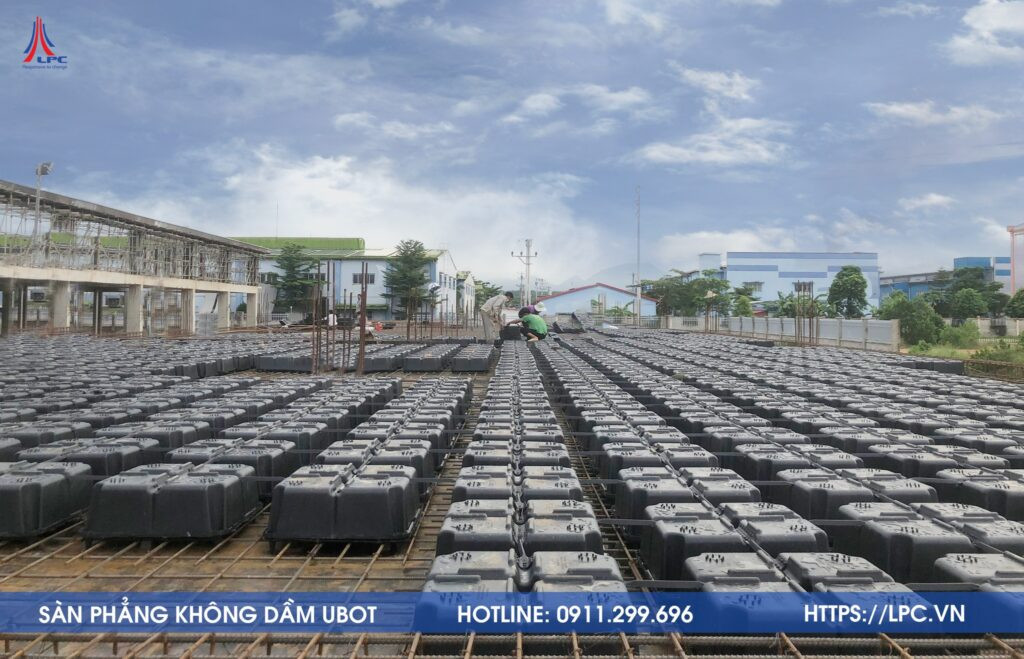
Advantages of Ubot hollow box slabs:
- Lightweight: The hollow design reduces slab weight, making transportation and installation easier.
- Sound and thermal insulation: Recycled plastic boxes help improve sound and thermal insulation for the building.
- Fast construction: The construction process becomes faster and more efficient thanks to the use of easy-to-install plastic boxes.
- Increased clear ceiling height: Ubot hollow box slabs help optimize space and increase the clear ceiling height of floors.
2.2. Prestressed large-span slabs
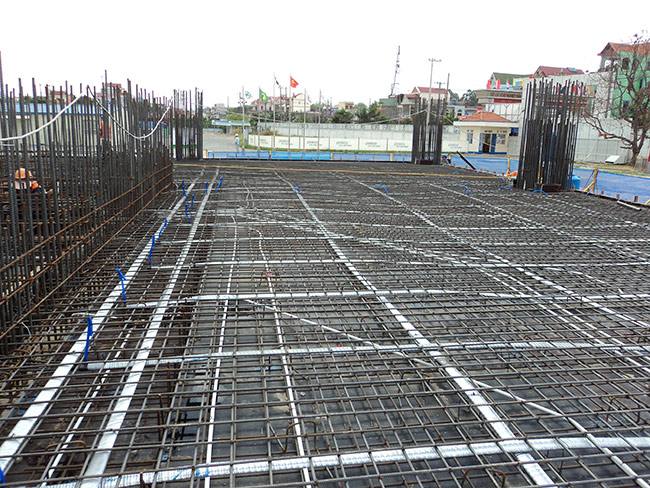
Prestressed large-span slabs are a type of reinforced concrete slab specially designed to span large distances without requiring many supporting columns. This structure uses prestressing cables placed within the slab, with tensioning and release performed at the anchor ends to create upward forces that balance the slab loads.
The slab can withstand large applied forces and achieve longer spans than conventional slabs. Prestressed slabs are commonly applied in large projects requiring spacious, column-free areas and high load-bearing capacity.
>> Learn more: Prestressed slabs combined with Ubot flat slabs
2.3. Mushroom slab (Flat Slab)

A Flat Slab is a type of beamless flat slab structure in which the reinforced concrete slab is placed directly on columns and walls. To enhance the shear resistance and stiffness of the slab system, Flat Slabs often use column heads, which are thickened sections positioned at columns and walls.
Column heads function similarly to T-beams at support locations, helping distribute loads from the slab to the columns more effectively, reduce local loads, and increase the slab's shear capacity. However, mushroom slabs have span limitations: for conventional concrete slabs, the maximum span is approximately 9.5 m, while when combined with prestressed slabs, the span can reach 12 m.
2.4. Flat Plate
A Flat Plate is a one-way or two-way load-bearing system supported directly by columns or load-bearing walls. This is a common slab structure in modern high-rise buildings.
- Constant thickness: A prominent feature of Flat Plates is their constant or nearly constant thickness. This creates a flat underside of the slab, simplifying formwork and construction.
- Design flexibility: Flat Plates allow partitions to be easily installed and, in many cases, eliminate the need for suspended ceilings.
2.5. Ribbed Slab and Waffle Slab
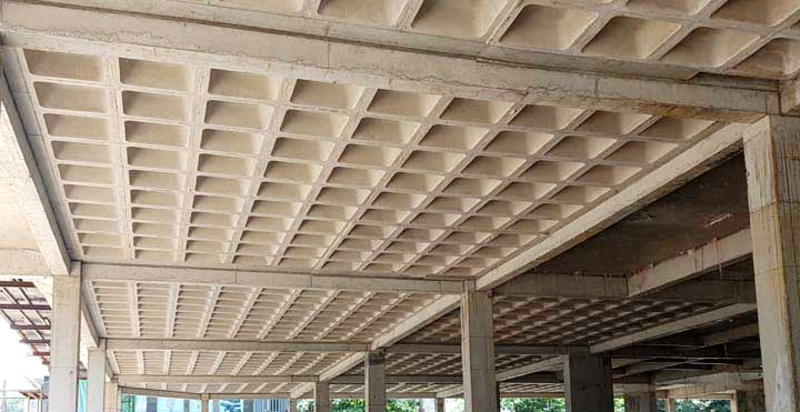
Ribbed slabs consist of multiple ribs arranged at fixed positions with equal spacing between them and are usually supported directly by columns. The ribs can be arranged in one direction (ribbed slab) or two directions (waffle slab). The advantages of ribbed slabs and waffle slabs include high load-bearing capacity, material savings, and flexibility. However, construction of these solutions is still relatively complex.
Characteristics and technical specifications:
- Slab thickness: 75–125 mm.
- Rib thickness: Minimum 125 mm.
- Rib width: 125–200 mm.
- Rib spacing: 600–1500 mm.
- Total slab thickness: Typically 300–600 mm.
- Slab span: Up to 15 m.
3. Ubot large-span slab structure
Today, large-span slabs almost always use beamless flat slab structural solutions. This is an ideal choice for large-span projects because, in addition to the technology that helps eliminate columns, flat slabs have a thinner profile and allow the positions of built walls to be changed flexibly when functions change.
3.1. Structural layout options for large-span flat slabs
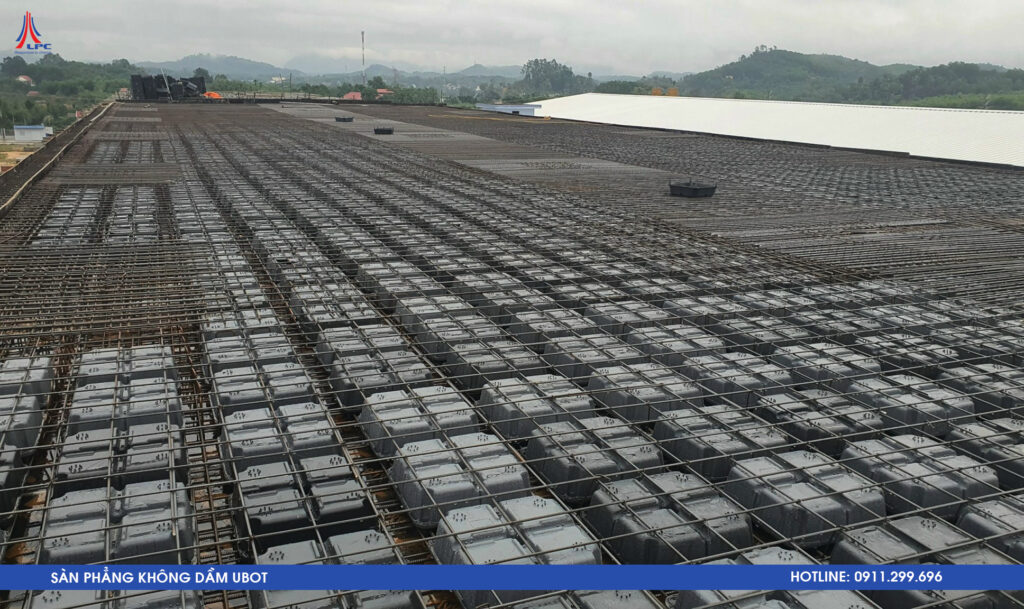
Hollow box flat slab:
- Beamless flat slab: Consists of slab strips passing over column heads and slab strips in the middle of the span.
- Column heads: To ensure punching shear resistance, the slab is made solid and has a drop panel.
Reinforcement arrangement for large-span slabs using plastic boxes:
- Load-bearing bottom reinforcement.
- Bottom reinforcement strengthening layer: Placed in areas of high bending moments.
- Plastic boxes, plastic balls, or foam: Placed above with a protective clearance of > 2 cm from the bottom reinforcement.
- Top reinforcement for thermal shrinkage.
- Top reinforcement for negative moments: Concentrated within L/3 on each side around the column head.
- Reinforcement strengthening the corners of openings.
- Reinforcement for concealed beams strengthening the staircase.
4. Experience in constructing large-span slabs
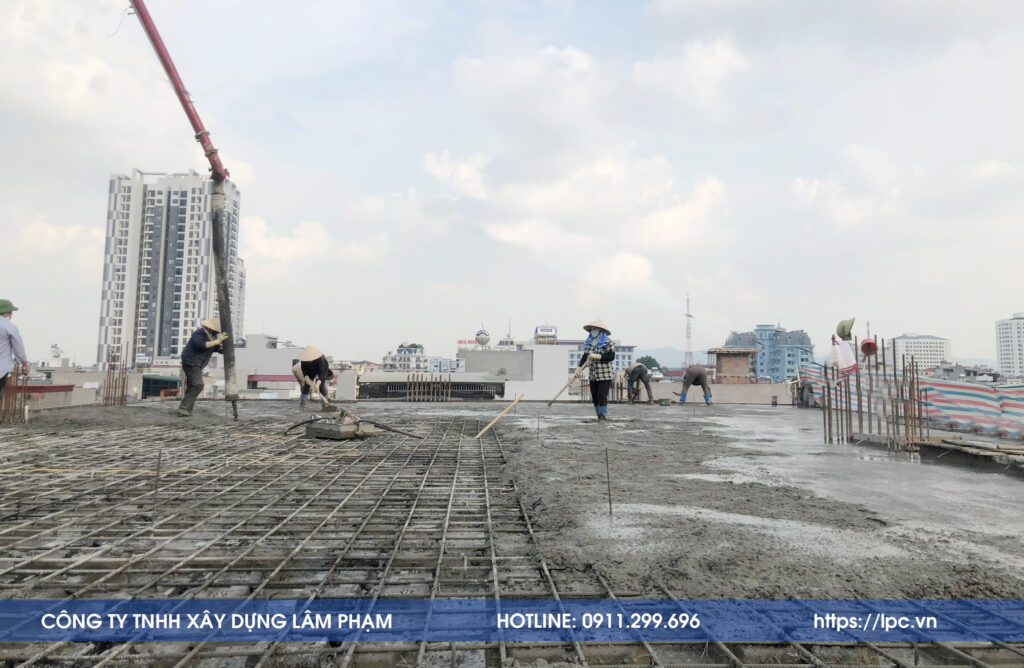
The complexity of large-span slab construction also depends heavily on the material solution selected by the investor. Currently, flat slab solutions using Ubot plastic boxes are more common because they are suitable for most types of projects, and construction becomes easier as on-site workers can carry out the work according to the transfer guidelines provided by the site engineer.
More complex solutions such as prestressed slabs or waffle slabs require an experienced construction team for implementation, and construction costs also increase significantly. When constructing large-span slabs, it is necessary to ensure that all construction stages and procedures comply with the design and technical instructions provided by the supervising site engineer.
When designing large-span slabs, several key issues need to be carefully considered:
- Column grid: Should only be 8–20 m.
- Select an appropriate slab technology.
- Check slab deflection.
- Check slab punching shear.
- Check edge beams and columns.
5. Latest pricing for Ubot large-span slabs

Depending on the material and architectural solution selected by the investor, the price of large-span slabs will vary accordingly. In practical applications, the cost-effective solution that still ensures structural efficiency is Ubot plastic boxes – Ubot flat slabs.
LPC (Lam Pham Construction Co., Ltd.) is the first company to transfer the beamless flat slab solution in Vietnam. With 13 years of experience in project management – site supervision – technology improvement and transfer, more than 1,600 projects nationwide have used Ubot flat slabs.
Lam Pham Construction Co., Ltd. – LPC
- Hotline: 0911.29.9696
- Website: https://lpc.vn
- Facebook: Lam Pham Construction
Related articles
View all
LONGITUDINAL BENDING COEFFICIENT η OF REINFORCED CONCRETE COLUMNS SUBJECTED TO ECCENTRIC COMPRESSION ACCORDING TO TCVN 5574-2018
According to TCVN 5574-2018, the longitudinal bending coefficient η is a parameter used in the structural calculation of reinforced concrete columns subjected to eccentric…

Directions for improving the quality of social housing today and in the future
On December 1, 2023, the Hanoi Association of Architects organized a discussion session entitled “Planning and Architecture of Social Housing – Present and Future”. At the…
Series on Foundations (Part 1)
Foundations play an important role in every construction project. To have a beautiful and sturdy home, the foundation must be built firmly and safely.
Building sustainable projects together
Follow expert knowledge from LPC engineers or contact us when you need advice.