Why is flat slab with hollow box formers widely chosen in construction?

In the modern construction industry, flat slabs with hollow box formers are one of the most widely preferred design types. Many people consider flat slabs with hollow box formers to be one of the most advanced and effective construction solutions. Why is that? Let’s find out in this article.
Current trend of flat slabs with hollow box formers
With the development of science and technology, the construction industry is also moving toward entirely new construction solutions that ensure the quality of buildings, reduce construction costs, deliver high economic efficiency, and are especially environmentally friendly. Therefore, flat slabs with hollow box formers have emerged as an optimal solution, addressing many of the technical, construction material, and structural durability limitations found in other slab systems.
In addition, construction methods for flat slabs with hollow box formers are simple, straightforward, and fast, helping save both time and labor.
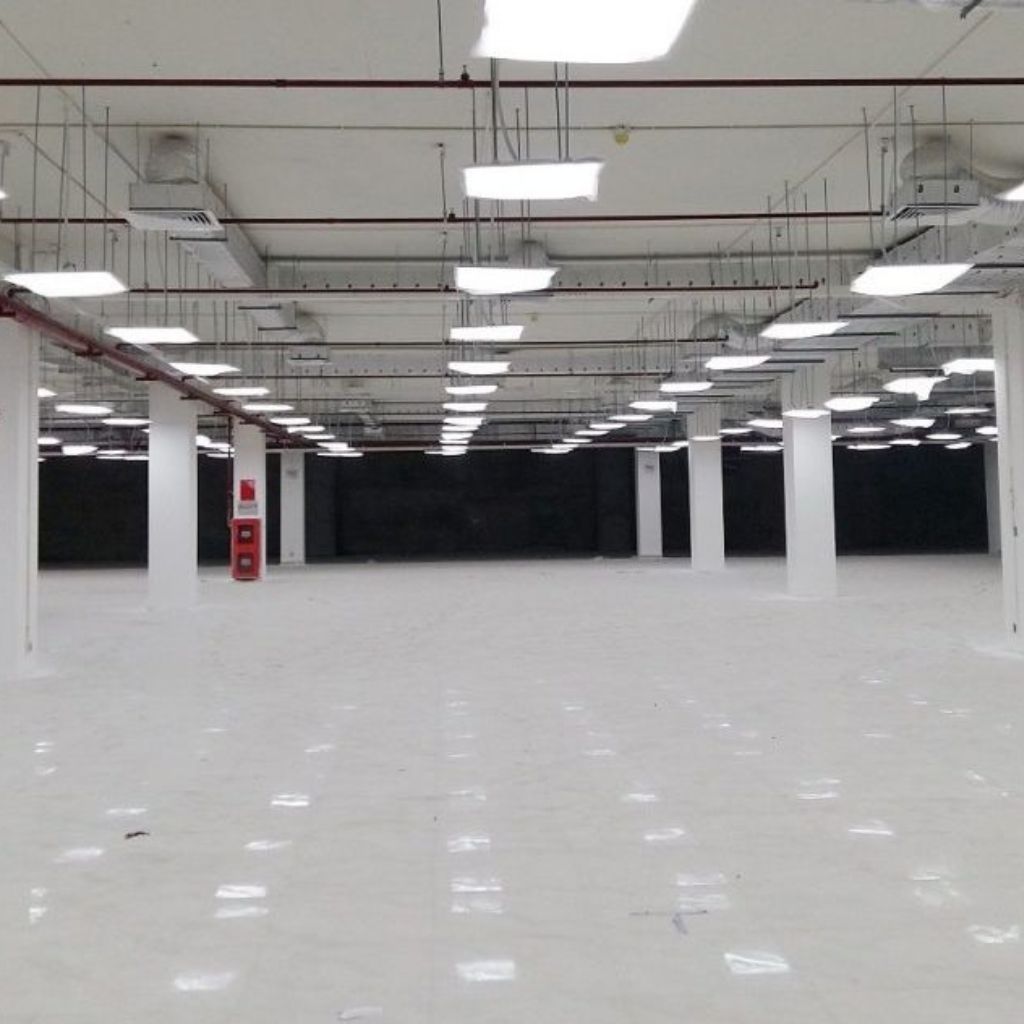
The key advantages offered by flat slabs with hollow box formers include:
- The slab can achieve spans of up to 20 m, creating open and spacious areas for the building
- The slab structure has no beams or column heads, enhancing the architectural aesthetics of the building while providing convenient space for technical piping beneath the slab
- Reduce the thickness of the beam-and-slab system
- With the same overall building height, the building can accommodate more floors because the thickness of the beam-and-slab system is reduced
- Improve sound and thermal insulation
- Reduce slab weight by 10–30% compared with conventional slabs, thereby reducing the load transferred to the foundations and allowing smaller foundations
- Reduce the number of columns and optimize column cross-sections
- Save up to 10–15% of total construction costs and 10–30% of the costs of concrete, reinforcement, formwork, labor, technical systems, and electrical and plumbing systems
- Environmentally friendly, with UBOT receiving quality certification for its recycled plastic components, which are safe for use. The construction of UBOT flat slabs requires very little scaffolding and formwork, significantly reducing waste released into the environment.
Therefore, hollow box slabs are used in public buildings, hospitals, industrial facilities, and more.
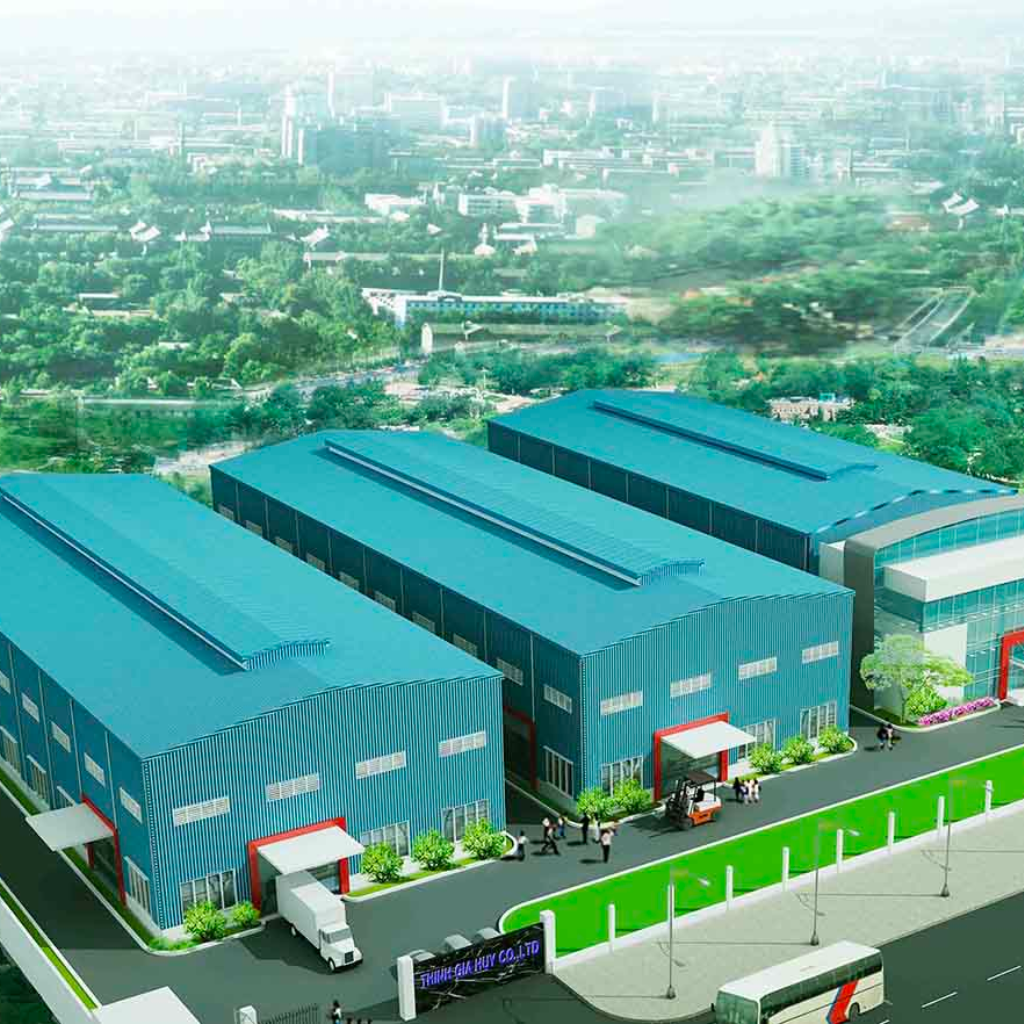
Flat slabs with hollow box formers – a solution that could change future construction trends?
In developed countries, beamless flat slab technology has been developed for a long time, dating back to the 1950s. Many flat slab technologies have been adopted by advanced countries, including Italy (Uboot slab technology), Denmark (bubble slab technology), and South Korea (foam slab technology).
Vietnam has also imported these technologies, and they are now widely applied across provinces and cities throughout the country because of the solution’s outstanding advantages and benefits.
In construction, flat slabs with hollow box formers are becoming increasingly popular because of their outstanding advantages over conventional reinforced concrete slabs. This is one of the more cost-effective and environmentally friendly slab systems, meeting the criteria for construction materials used in sustainable development. Beamless flat slabs can achieve large spans of 7–20 m and offer many advantages over conventional beam-and-slab systems.
The most noticeable advantages include creating open spaces with a spacious column grid, flexible column positioning within the functional layout, and a smooth slab surface combined with the natural appearance of concrete, creating modern architectural spaces that are simple yet elegant and comfortable. In addition, the system provides excellent sound and thermal insulation as well as flexibility in wall construction and functional layout, among other benefits.
Major projects using flat slabs with hollow box formers include “Ligoci 13 Apartment Building (Hanoi, 29,000 m² of floor area), 28A Le Trong Tan Apartment Building (Hanoi, 20,000 m² of floor area), 423 Minh Khai Apartment Building (Hanoi, 100,000 m² of floor area), Ecohome Phuc Loi Apartment Building (60,000 m² of floor area).” On average, hundreds of thousands of square meters of floor area are constructed each year using beamless flat slab systems.

Some of the flat slab solutions and systems currently available include: flat slabs with hollow box formers (Uboot, Nevo, Tbox, Lform, etc.), foam slabs, waffle slabs, bubble slabs, prestressed slabs, deck slabs, and more.
Waffle slab also has a long history dating back to the 1950s.
A waffle slab is a type of reinforced concrete slab with numerous secondary beams arranged in a waffle pattern, while the concrete slab itself can be as thin as 5 cm. Because of its thin slab thickness and light weight, structures with large and medium spans that use this type of slab have the lowest concrete and reinforcement material costs compared with other concrete slab systems.
However, constructing this type of slab is relatively complex, increasing construction time and costs. In 2009, Dr. Nguyen Xuan Hoang, Director of ACH Construction Consulting Joint Stock Company, developed a new construction technology and was granted an exclusive patent by the Ministry of Science and Technology.
In 1990, bubble deck was invented by Professor Jorgen Breuning of Denmark. This lightweight concrete slab uses recycled plastic balls to replace the non-load-bearing concrete in the middle layer of the slab. This significantly reduces the dead weight of the structure and increases the spanning capacity by approximately 50%.
Foam slab (Expanded Polystyrene System) originated from 3D prefabricated foam wall panel technology developed in Europe in 1985. Around 2012, M.Sc. Hoang Duc Thang from Hanoi University of Civil Engineering researched and improved the technology to suit the development of the solution in Vietnam.
The UBOT box solution – molded void formers made from recycled polypropylene to create large-span beamless flat slabs.
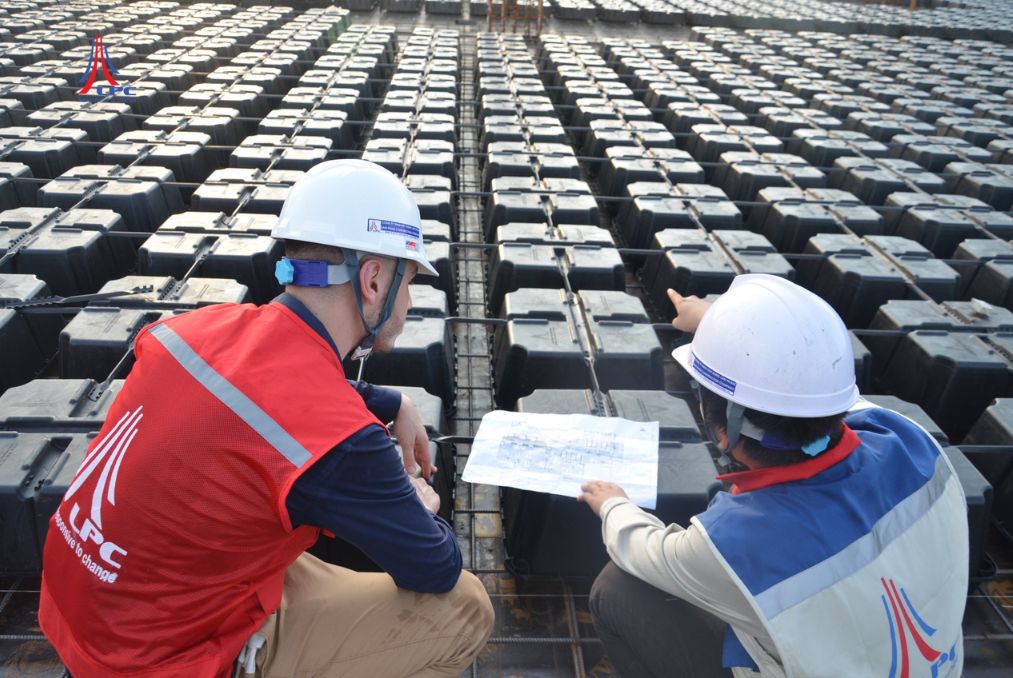
Since 2012, LPC has received technology transfer from Daliform Group (Italy) and has continued to develop and refine the solution. After being implemented in hundreds of large- and small-scale projects both domestically and internationally, UBOT Beton is now one of Vietnam’s leading large-span flat slab solutions.
Today, with the UBOT solution, buildings become more open and architecturally appealing, while functional layouts can be arranged more easily without compromising the required construction quality. Placing UBOT void formers in the slab removes non-load-bearing concrete, reducing slab weight and the amount of concrete and reinforcement required, while allowing spans of up to 20 m and creating open, aesthetically pleasing spaces within the building.
Each type has its own characteristics, advantages, and disadvantages depending on the function and specific requirements of each project; however, they can all generally be classified as flat slab solutions.
Related articles
View all
LONGITUDINAL BENDING COEFFICIENT η OF REINFORCED CONCRETE COLUMNS SUBJECTED TO ECCENTRIC COMPRESSION ACCORDING TO TCVN 5574-2018
According to TCVN 5574-2018, the longitudinal bending coefficient η is a parameter used in the structural calculation of reinforced concrete columns subjected to eccentric…

Directions for improving the quality of social housing today and in the future
On December 1, 2023, the Hanoi Association of Architects organized a discussion session entitled “Planning and Architecture of Social Housing – Present and Future”. At the…
Series on Foundations (Part 1)
Foundations play an important role in every construction project. To have a beautiful and sturdy home, the foundation must be built firmly and safely.
Building sustainable projects together
Follow expert knowledge from LPC engineers or contact us when you need advice.