Calculation of reinforced concrete slab deflection according to TCVN 5574:2018 using SAFE
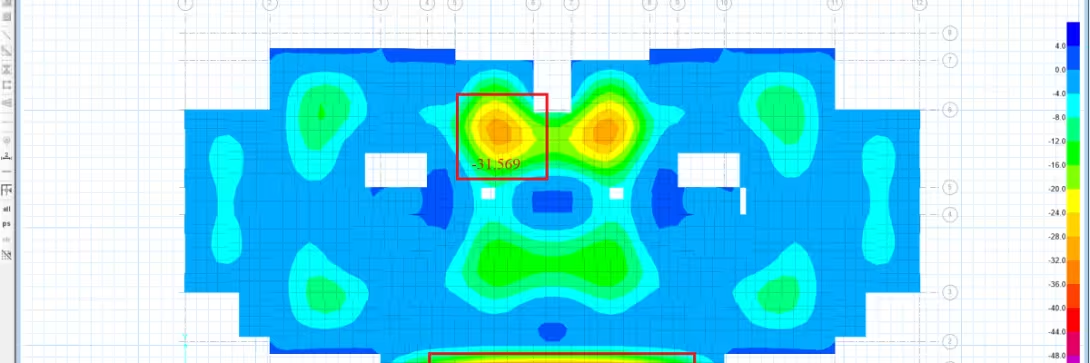
Slab deflection calculation is one of the essential requirements to ensure the safety, economy, and aesthetics of a building. In design, we must always ensure that structural members meet the requirements for strength (first limit state) and deformation (second limit state).
Let’s explore with LPC how to calculate reinforced concrete slab deflection using SAFE software.
1. What is slab deflection calculation?
Deflection and cracking in reinforced concrete structures are often a concern for investors and building users. The effects of deflection and cracks can negatively affect the architectural appearance of the building, reduce the durability of the structure, and compromise structural safety.
Therefore, calculating slab deflection helps ensure structural integrity and minimize the risk of slab deflection and cracking during construction and throughout the building’s service life.
2. Theoretical basis for slab deflection calculation
- Deformation (deflection) is calculated according to the second limit state, using characteristic loads (without load factors).
- Deflection must be calculated under the action of:
- Permanent, long-term temporary, and short-term temporary loads when deformation needs to be limited due to technological or structural requirements.
- Permanent and long-term temporary loads when deformation needs to be limited due to aesthetic requirements.
- When considering the long-term behavior of reinforced concrete structures, creep and shrinkage, as well as the long-term effects of different types of loads, must be taken into account.
- If deflection mainly depends on bending deformation, the deflection value is determined based on curvature.
- According to section 8.3.2.1 of TCVN 5574:2018:
- The deflection of reinforced concrete members is calculated according to the condition:
f ≤ fu
Where:
f: is the deflection of the reinforced concrete member under the action of external forces.
fu : is the allowable deflection limit of the reinforced concrete member.
3. Practical calculation
In practical slab deflection calculations, SAFE software and Eurocode 2 can be used with equivalent material parameters to analyze and determine slab deflection. This article uses SAFE V12.
The total deflection f is calculated as follows:
f = f1 – f2 + f3
- Where:
- f1 – deflection due to the short-term effect of the total load
- f2 – deflection due to the short-term effect of the long-term load
- f3 – deflection due to the long-term effect of the long-term load
- Load cases:
- Self-weight of the structure (DL)
- Load from finishing layers (SDL)
- Load from enclosure walls (WL)
- Live loads (LL12 , LL13)
3.1. Building the calculation model.
- Method 1: Create the model directly in SAFE.
- Method 2: Export the slab model to be calculated (as an .f2k file) from the ETABS model.
3.2. Selecting the applicable standard.
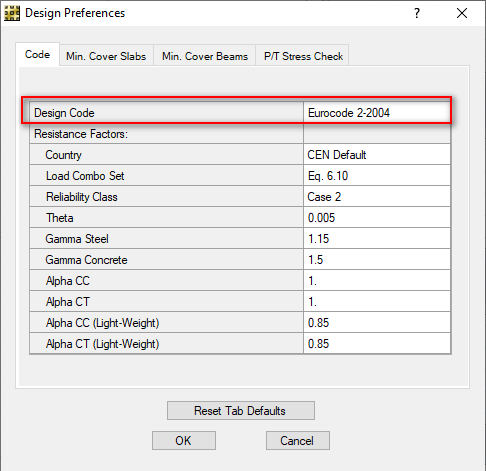
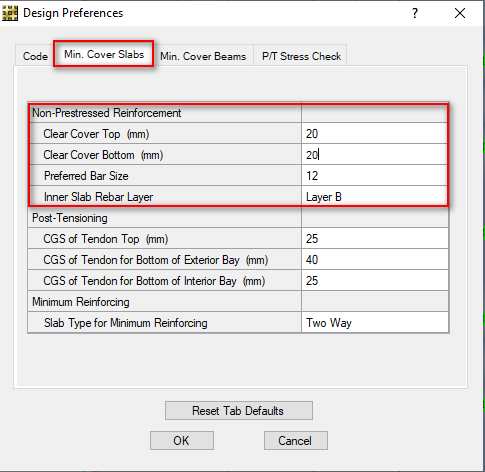
Go to Design => Design Preferences
Code section: Select the standard
Min.Cover Slabs section: Select the concrete cover and reinforcement layer position.
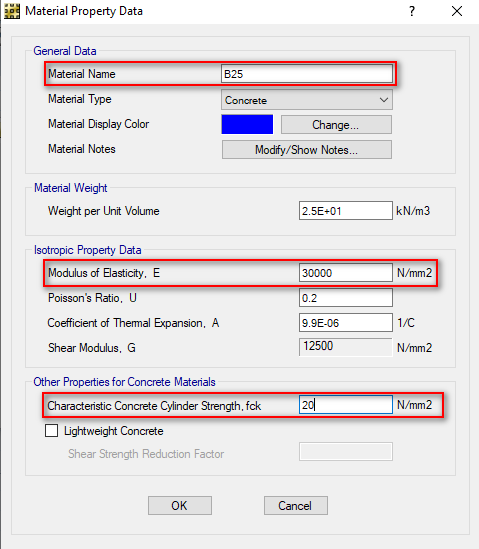
3.3. Defining material properties.
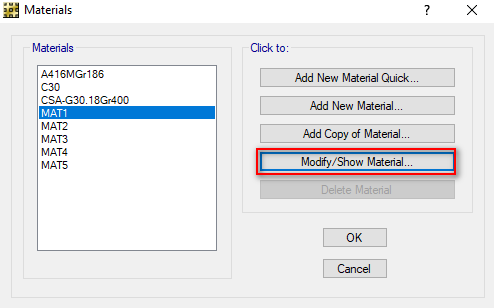
Go to Define => Materials
- Check and adjust the material parameters exported from ETABS.
- Select MAT1 => Modify / Show Material…
3.4. Defining reinforcement parameters for crack analysis.
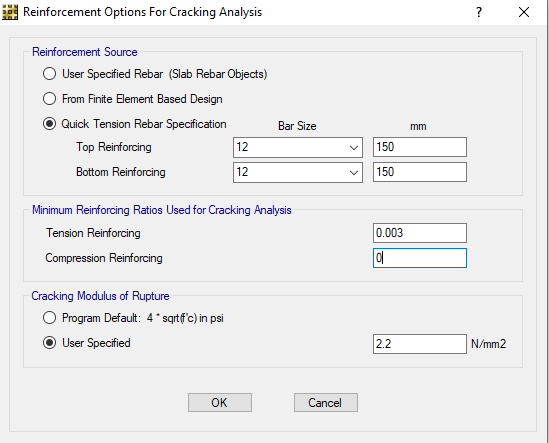
Go to Run => Cracking Analysis Options
- Reinforcement Source section:
- From Finite Element Based Design: Reinforcement calculated automatically by the program. (default option)
- Quick Tension Rebar Specification: User specifies the reinforcement.
- Minimum Reinforcing Ratios Used for Cracking Analysis section: Minimum reinforcement ratio for crack calculation. μ = 0.003 can be used.
- Cracking Modulus of Rupture: Select either of the two options.
- Program Default : The program calculates it automatically.
- User Specified : User specifies the parameter fctm -Average tensile strength of concrete at 28 days. Concrete B25 has fctm = 2.2 MPa

3.5. Defining load cases for slab deflection calculation.
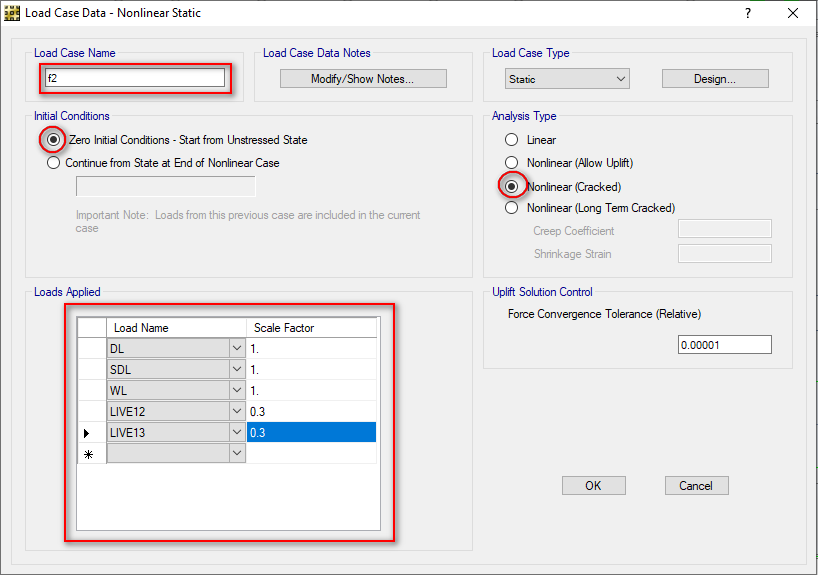
Go to Define => Load Cases => Add New Case…
- f1:- deflection due to the short-term effect of the total load.

- f2 – deflection due to the short-term effect of the long-term load
-
- According to TCVN 2737-1995, live loads have two components: total and long-term. The long-term portion usually accounts for 20%–35%. A value of 0.3 can be approximately used for most types of live loads.
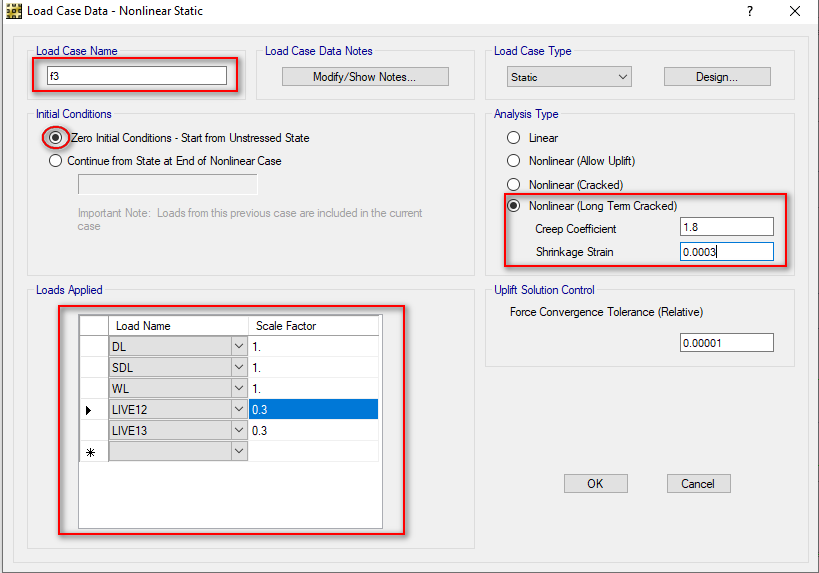
- f3 – deflection due to the long-term effect of the long-term load
-
- This combination accounts for the long-term effect of long-term loads, using two parameters: Creep Coefficient (CR) for creep and Shrinkage (SH) for concrete shrinkage.
- The creep coefficient given in Table 11 of TCVN 5574:2018 depends on the strength class and the relative humidity of the surrounding environment.
- For B25 and humidity above 75%, CR = 1.8. The SH coefficient can be taken as 0.0003 or determined through calculation.

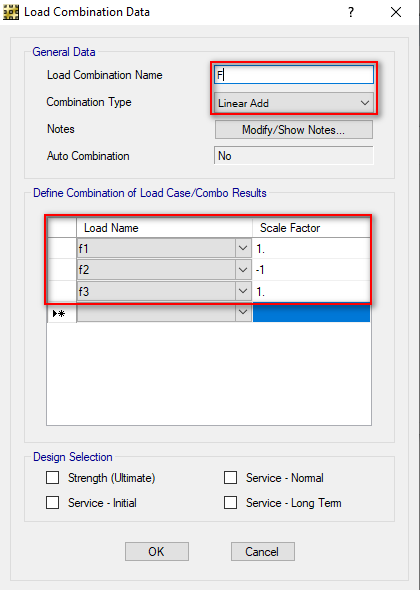
- Defining load combinations for slab deflection calculation:
- f = f1 – f2 + f3
- Go to Define => Load Combinations… => Add New Combo…
3.6. Viewing the analysis results after calculating slab deflection
Go to Run => Run Analysis & Design to run the model analysis.
Go to Display => Show Deformed Shape… to view the slab deflection results.

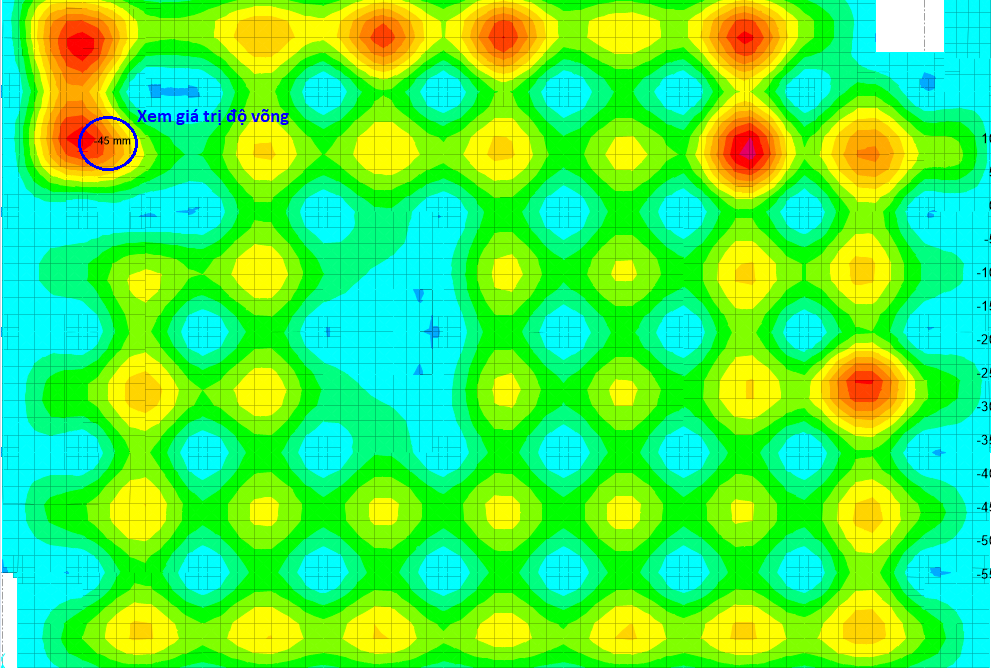
- Deflection value:

-
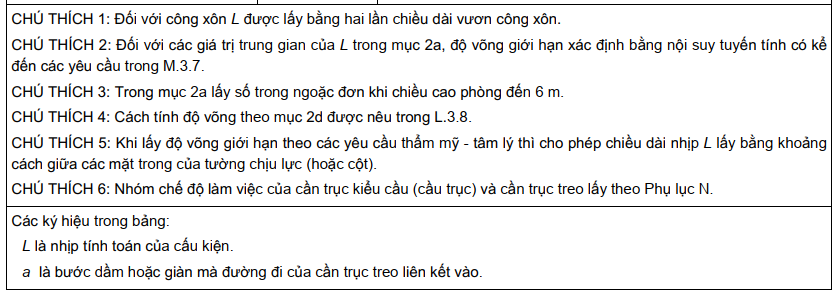
- Relative deflection of the slab panel in the Lx direction: Δx = Δ – 0.5(Δx1+Δx2)
- Relative deflection of the slab panel in the Ly direction: Δy = Δ – 0.5(Δy1+Δy2)
- Deflection check: max(Δx,Δy) < [Δ]
- [Δ] : Deflection limit, taken according to Table M.1 of TCVN 5574:2018

—- Lam Pham Construction Company Limited – LPC
Hotline: 0911.29.9696
Website: https://lpc.vn
Facebook: Lam Pham Construction
Youtube: Lam Pham Construction
Tiktok: Lam Pham Construction
Related articles
View all
LONGITUDINAL BENDING COEFFICIENT η OF REINFORCED CONCRETE COLUMNS SUBJECTED TO ECCENTRIC COMPRESSION ACCORDING TO TCVN 5574-2018
According to TCVN 5574-2018, the longitudinal bending coefficient η is a parameter used in the structural calculation of reinforced concrete columns subjected to eccentric…

Directions for improving the quality of social housing today and in the future
On December 1, 2023, the Hanoi Association of Architects organized a discussion session entitled “Planning and Architecture of Social Housing – Present and Future”. At the…
Series on Foundations (Part 1)
Foundations play an important role in every construction project. To have a beautiful and sturdy home, the foundation must be built firmly and safely.
Building sustainable projects together
Follow expert knowledge from LPC engineers or contact us when you need advice.