Net Zero and Future Construction Trends
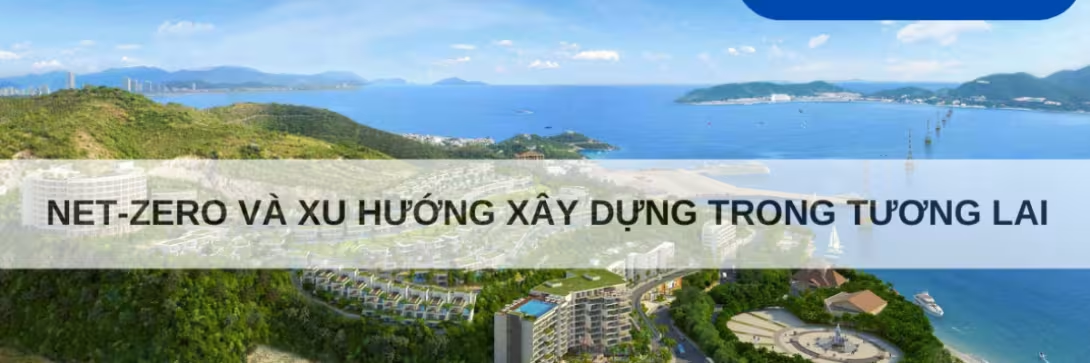
Net Zero and Future Construction Trends
Currently, climate change is the most pressing issue of our time. Therefore, governments, city authorities, and companies need to establish specific standards to limit carbon emissions generated by industries in general and the construction industry in particular, thereby ensuring a “green” and sustainable environment for people. Therefore, the “Net Zero” standard is considered one of the most effective solutions to this issue.

According to the United Nations Environment Programme (UNEP), the built environment accounts for 39% of total annual carbon emissions worldwide, of which 11% is generated from the production of construction materials such as steel, cement, and glass. Although architects and designers have made significant technological advances by applying recycled materials and green materials to construction processes, there is still a long way to go to achieve Net Zero and reduce carbon emissions to the minimum or nearly “zero” level.
What Is Net Zero?
Net Zero (net-zero emissions) is defined on the Net Zero Climate website as “a state of balance between the amount of greenhouse gases entering the atmosphere and the amount of gases removed from it.”
This means that people must find ways to minimize the amount of CO2 released into the natural environment from sources such as transportation, industrial plants, and especially the construction sector. At the same time, the remaining amount of CO2 in the atmosphere must be balanced by the amount of gas removed. Therefore, Net Zero is also considered a goal of reducing CO2 emissions associated with green restoration and sustainable development.
Why Does the Construction Sector Need to Strive for Net Zero?
According to the Global Status Report 2018 by the International Energy Agency (IEA), CO2 emissions from buildings accounted for 40% of total global CO2 emissions from energy use in 2017. Of this, emissions from building operations accounted for 28%, while emissions from construction materials accounted for 11%.

Chart showing global CO2 emissions. Source: Architecture 2030
According to the same report, two-thirds of the floor area of buildings currently in existence will still be standing in 2040. This means that if these buildings do not reduce CO2 emissions and do not clearly define steps toward achieving Net Zero, the Paris Agreement’s goal of limiting the increase in global temperatures will not be achievable.
So, what does the construction industry need to do to achieve Net Zero more quickly???
Future Construction Trends
Green Construction Materials
Green construction materials are materials that are produced and used without causing harm to the environment and that can be recycled or naturally decomposed. Throughout their life cycle, from production to the end of their useful life, green construction materials do not create any negative impacts on the living environment.

Green construction materials are being encouraged for use worldwide and in Vietnam to reduce carbon emissions in the construction industry and move toward the Net Zero goal. Although green materials often have relatively high production and installation costs, along with limitations in construction capacity and contractors’ investment budgets, the use of green materials still faces many barriers and has not yet developed to its full potential.
See also: https://lpc.vn/kien-truc-xanh-xu-huong-cua-hien-tai-va-tuong-lai/
However, in the long term, these materials can save more costs than traditional materials. The current production process for green construction materials needs to meet two criteria:
– Consume less energy to produce construction materials.
– Consume less energy when the materials are used.
Green materials not only avoid negative environmental impacts but are also safe for users and can be reused multiple times. Examples include bamboo, non-fired bricks, lightweight concrete, and a slab system that is currently gaining popularity: LPC’s Ubot flat slab.

Ubot is a formwork product made from recycled Polypropylene used in slab and raft foundation structures, making it highly suitable for environmental protection and Net Zero standards. Placing Ubot boxes within the slab removes non-load-bearing concrete, reducing slab weight and the amount of concrete and reinforcement used, while allowing the slab to achieve spans of up to 20 m and creating open, aesthetically pleasing spaces within the building.
In the future, we should fully transition to these types of materials to gradually move toward the Net Zero goal.
You may also be interested in: https://lpc.vn/san-phang-ubot-ung-dung-linh-hoat-trong-cac-cong-trinh/
Sustainability
Sustainability in architecture refers to buildings designed to minimize human impact on the natural environment.
Sustainable architecture uses renewable energy sources, such as solar panels for heating systems and skylights to provide natural ventilation, while minimizing the waste of harmful energy sources.

In addition, sustainable architecture must enable sustainable operation throughout the building’s life cycle, including final disposal. At the same time, it must still achieve functionality and superior aesthetics while ensuring long-term resource and energy efficiency.
Sustainability in architecture is an architectural model designed and developed toward integration with nature and closer connections to nature, with the aim of preserving environmental and ecosystem balance. This is also one of the innovations toward achieving Net Zero in the construction industry.
Building Renovation
Building renovation is a way to save an old building that is at risk of being demolished. Today, with the rapid emergence of high-rise buildings, housing demand, and a shortage of green spaces, many environmental and social issues have arisen.
One way to address this is to renovate existing buildings, add new features, and create necessary functions suited to modern life instead of choosing demolition and complete redevelopment, which generates large amounts of carbon emissions. Renovation brings many environmental benefits and gradually moves toward the Net Zero goal in construction. Furthermore, it helps preserve natural resources and reduce the demand for new materials.

Some of LPC’s notable renovation projects contributing to environmental protection include: Hàm Long Office Building, Hyundai TC – Motor Product and Service Experience Center (CDA Tam Trinh), Thanh Cong Automotive Service and Infrastructure Center, and more. Upgrading and renovating existing buildings can provide economic benefits by reducing electricity consumption and other operating costs. In addition, not demolishing buildings helps reduce carbon emissions into the environment, improve quality of life, and protect the health of people living there.
See also: https://lpc.vn/top-3-xu-huong-kien-truc-cai-tao-nha-dep-va-an-tuong/
Therefore, to achieve Net Zero (net-zero emissions) by 2050, the construction industry will need to undergo transformation starting from the extraction and use of raw materials through to the final stages of completing a construction project. In other words, the construction industry will have to play its role in contributing to a common goal, not only for one country but for all humanity.
——Lam Pham Construction Company Limited – LPC
Hotline: 0911.29.9696
Website: https://lpc.vn
Facebook: Lam Pham Construction
Youtube: Lam Pham Construction
Tiktok: Lam Pham Construction
Related articles
View all
Long-span flat slabs in modern architecture
Long-span flat slabs – where architects create sophisticated architectural beauty. Architectural beauty is understood as the organization and arrangement of spaces with functional…

Green materials and economic efficiency in construction – Can they go hand in hand?
Today, a popular trend being adopted by the construction industry both globally and domestically is the production of environmentally friendly construction materials using new…
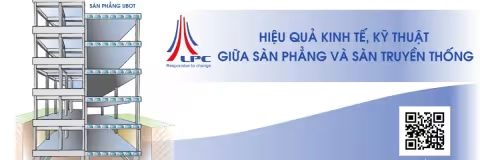
ECONOMIC AND TECHNICAL EFFICIENCY OF FLAT SLABS COMPARED TO TRADITIONAL SLABS
Today, voided slabs, lightweight concrete slabs, also known as flat slabs, have established their position compared to traditional concrete slabs. With advantages in architecture,…
Building sustainable projects together
Follow expert knowledge from LPC engineers or contact us when you need advice.